Last updated November 18, 2026



Free written scope consultation - allowances, timeline, and change-order rules on paper before a single trade is scheduled
Driveway & Pavers Warning Signs Every Homeowner Should Know
A rocking paver isn’t a loose paver. It’s a drainage problem. The water that worked its way under that one stone has been quietly eroding the bedding sand beneath the forty pavers around it, and by the time you can feel three of them shift underfoot, the sub-base repair has already tripled in scope. We’ve watched this play out in driveways across North Las Vegas, and the pattern is almost always the same: the failure was visible for a year before anyone called. This guide turns you into someone who can read a driveway the way a contractor does. You’ll learn the five early-stage failure patterns, how to separate cosmetic aging from structural compromise, and what’s specific to North Las Vegas soil and sun.
Quick Answer
The five warning signs that matter most on a paver driveway are rocking stones, sinking or settling areas, joint sand erosion, edge separation, and surface spalling. Cosmetic aging is normal and cheap to live with. Structural compromise – pooling water, widespread rocking, or a widening gap at the edge – means the sub-base is failing and the repair cost climbs every month you wait. In North Las Vegas, caliche heave and UV spalling show up earlier than most homeowners expect.
Styles & brands we work with
- Kitchen remodeling
- Bathroom remodeling
- Home additions & ADU
- Roofing
- Windows & doors
- Driveway & pavers
- Fence
Table of Contents
- Why Your Driveway Is Talking to You
- The Five Early-Stage Failure Patterns
- Cosmetic Aging vs. Structural Compromise
- Warning Signs Unique to North Las Vegas
- The 10-Minute Monthly Walk-Through
- Call Today vs. Watch for 90 Days vs. Fix It Yourself
- Common Mistakes to Avoid
- Frequently Asked Questions
Why Your Driveway Is Talking to You
Interlocking pavers are a system, not a surface. The stone you see is the top of a stack that starts with compacted aggregate base, moves up through a bedding sand layer, holds the pavers, and finishes with joint sand that locks everything together. Each layer depends on the one below it. When the base holds, the driveway can take decades of traffic. When the base moves, the pavers above it telegraph that movement in ways you can see and feel long before the system actually fails.
That’s the good news buried inside a bad situation. A paver driveway rarely collapses without announcing itself. The warning window on most failures runs anywhere from six to eighteen months. The homeowner who reads the signs early spends a fraction of what the homeowner spends after the sub-base has washed out under a 600-square-foot section.
We see the cost curve clearly in North Las Vegas. A joint sand refill on a driveway in Aliante runs a few hundred dollars. Let that same joint erosion funnel monsoon runoff into the base for two seasons and you’re looking at base reconstruction, new aggregate, recompaction, and resetting stone – a job that lands in the thousands. Same driveway. Same failure. Different timing.
There’s also a safety layer here. A rocking paver is a trip hazard for anyone walking to the door, and loose stone at the edge of a driveway invites the kind of sideways twist that sends people to urgent care. That alone justifies a monthly look.
Think of it this way: your driveway doesn’t need you to be a mason. It needs you to be a reader. Once you know what the five patterns look like, you can spot a developing problem in under ten minutes and decide whether it’s a weekend fix, a 90-day watch, or a call to a professional. That decision is the whole game.
The Five Early-Stage Failure Patterns
Here’s a plain-language diagnostic guide to the five patterns we diagnose most often. For each one, we’ll describe what it looks like to your eye, what’s actually happening underneath, and whether the pattern is usually cosmetic or structural.
- Rocking pavers. You step on a stone and it tips, or you hear a hollow click when you walk across a section. The stone isn’t loose in the sense of being about to flip out. It’s rocking because the bedding sand under one edge has washed away or compacted unevenly, so the paver is now sitting on three points instead of four. At Groundwork we treat a single rocking stone as a one-stone repair. We treat three or more rocking stones in the same zone as a drainage investigation, because the pattern tells you water is moving where it shouldn’t.
- Sinking or settling. A dip in the driveway that wasn’t there last year, or a section that seems lower than the surrounding field. A shallow dip of a quarter inch or less is usually normal consolidation in a newer driveway. Anything deeper, or a dip that fills with water and stays filled for hours, points to base loss underneath. In the heavy caliche zones north of Craig Road, we also see dips that are actually heave somewhere else – the driveway is being pushed up on one side and appears to sink on the other.
- Joint erosion. The sand lines between pavers are supposed to sit about an eighth of an inch below the stone surface, packed tight. When those joints look deep, wide, or empty – when you can see down into them like a crack – the joint sand has washed out. Look for a dark stain or a fine sand trail at the base of your driveway after rain. That’s your joint sand leaving the property.
- Edge separation. The pavers at the side of the driveway pull away from the edge restraint, leaving a widening gap. On a properly built driveway, the edge restraint is locked in place and the last row of pavers butts tightly against it. When that gap grows a quarter inch or more, the restraint has moved or failed, and the entire outer row is now unsupported laterally. This one escalates fast. Address it in the same season you notice it.
- Surface spalling. The top layer of the paver flakes, peels, or pits. A small scuff or a chipped corner from a wheel hit is normal. A pattern of flaking across many stones, especially on the sun-facing side of the driveway, is spalling, and it can come from freeze stress, salt exposure, cheap stone, or plain UV wear.
Those five patterns cover the overwhelming majority of early failures on the driveways we evaluate in North Las Vegas. If you can name which pattern you’re looking at, you can predict what happens next.
Cosmetic Aging vs. Structural Compromise
Every driveway ages. Not every aging is a problem. Here’s how to draw the line for each pattern, and where we recommend action.
- Rocking: One or two isolated stones that move slightly = cosmetic to minor. Three or more in the same zone, or any rocking that grows month over month = structural. Investigate drainage.
- Sinking: A quarter-inch dip spread over three or more feet = cosmetic consolidation. Any dip that holds water, any dip deeper than half an inch, or any sinking at the edge = structural.
- Joint erosion: A few thin joints with slightly low sand = routine maintenance. Deep joints everywhere, sand trails after rain, or weeds growing in the joints = structural risk to the base.
- Edge separation: A hairline gap you can barely fit a credit card into = watch it. A visible gap, a wobbly edge stone, or grass and weeds in the gap = call a professional this week.
- Spalling: A few chipped corners = cosmetic. A repeating pattern across many stones, especially if you see the aggregate core exposed = the surface is degrading and the stone is on a clock.
There’s a useful rule of thumb we hand homeowners in North Las Vegas: cosmetic problems are ones you can ignore for a year without them getting worse. Structural problems are ones that will be measurably worse in six months. If you can’t tell which side of that line you’re on, that’s when you get an opinion.
The line matters because it changes the repair. Cosmetic spalling gets a clean and a sealer. Structural spalling across a wide area means replacing the affected pavers and checking the base for water intrusion. Cosmetic edge separation is a gap you watch. Structural edge separation means re-setting the restraint, which is real work.
Warning Signs Unique to North Las Vegas
North Las Vegas is not a forgiving climate for pavers. The combination of extreme UV, hard water, caliche soil, and flash monsoon runoff creates failure patterns you won’t see in most of the country. If you’ve moved here from a temperate city, your diagnostic instincts are calibrated wrong, and that’s normal.
Caliche Heave Patterns
Caliche is a calcium-carbonate layer common in the desert soil across North Las Vegas, especially north and east of the I-215. It behaves like a natural concrete shelf under the topsoil. When water reaches caliche and can’t move, it can swell and push up. Pavers over a shallow caliche shelf can heave in a characteristic pattern – a ridgeline or crown that runs in a generally linear direction, with wobbly stones on either side of the crown. If your driveway suddenly develops a ridge that wasn’t there, suspect caliche before you suspect the paver installer.
Hard Water Mineral Streaking
Our water is loaded with calcium and magnesium. Sprinkler overspray and irrigation runoff leave white, chalky streaks down the pavers that look like efflorescence and often are. Streaking that appears after irrigation cycles and washes away partially with rain is cosmetic. White crust that won’t move with a stiff brush or a light acid wash is mineral locked into the stone, and it signals that water is sitting on the surface – which points back to joint erosion or a puddle that isn’t draining.
UV Spalling vs. Manufacturing Defects
Paver manufacturers apply a pigment through the top layer to give the stone its color and to shield it. Cheap or poorly made pavers can spall from a manufacturing defect, where the whole batch goes wrong. But in North Las Vegas, sun exposure is the overwhelming cause. Pavers with southern and western exposure spall first. If spalling starts anywhere and progresses toward the sun-facing side, that’s UV wear. If spalling starts abruptly on one pallet’s worth of stone and spreads only within that section, that’s more likely a manufacturing defect – worth a call to whoever supplied the stone.
Brands like PGT, CGI, and ES Windows are all rated for desert exposure and the same logic applies to paver materials: buy from manufacturers who build for the sun you actually have. We help North Las Vegas homeowners choose stone that’s rated for this climate so the driveway doesn’t spall in its first decade.
The 10-Minute Monthly Walk-Through
This is the entire diagnostic process. Do it once a month, ideally the first weekend after a rain, and it takes under ten minutes. No tools required beyond your feet, your eyes, and a garden hose.
- Walk the full perimeter, starting at the street and working back. Use your feet, not just your eyes. A rocking paver feels different than a sound one; you’ll feel the tip and hear the click. Pay attention to the first row of pavers at the apron and the last row at the garage.
- Check the joint lines at eye level. Crouch down from a few feet back and look across the surface. Joints that look deep, missing, or dark are your erosion indicators. Look for fine sand trails near the edges and at the low point of the driveway.
- Look at the edges. Run a hand along the edge restraint on both sides. Is there a gap between the last paver and the restraint? Has the restraint cracked or shifted? Grab a paver at each corner and see if it moves sideways.
- Hose the driveway and watch the water. Spend a minute with a garden hose or wait for a real rain and check what happens. Water should sheet toward the street or a drain without pooling. If a puddle stays more than an hour after rain, you have a grade problem or a base problem, and those are two different fixes.
- Look for streaks and crust. Walk the sun-exposed side of the driveway and check for white mineral streaks, especially where irrigation hits. Note whether they change after rain.
- Note anything new on a calendar. Write down the date next to which pattern you saw. This is the single highest-value thing you can do, because the time-trend of a warning sign is what separates a watch from a call.
Annual deep checks: once a year, in the spring, refill low joint sand as needed and inspect the edge restraint on all sides after winter. North Las Vegas gets freeze events in the outer neighborhoods, and a hard freeze after a wet winter is when most spalling and edge failures declare themselves. If your driveway is showing the signs of a bigger issue, our Driveway & Pavers in North Las Vegas service handles full diagnostic and repair.
Same logic serves your other exterior systems: fence posts rock in the same base soils, and box stores sell fence materials that spall the same way. If you’ve got paver problems, take a look at your Fence Installation in North Las Vegas while you’re outside, and if you’re considering an addition or ADU, the same base-prep discipline applies. Our Home Additions & ADU in North Las Vegas work starts with the same soil you’re checking under the driveway.
Call Today vs. Watch for 90 Days vs. Fix It Yourself This Weekend
We hand homeowners in North Las Vegas this framework because it converts a vague worry into a decision. The rule is simple: match the severity, not the nervousness.
Call a professional today
- Three or more rocking stones in the same section, or rocking that grew since last month.
- Any puddle that stays on the surface more than an hour after rain.
- A gap at the edge restraint with a wobbling edge stone.
- A dip that’s appeared suddenly, especially a crown-shaped ridge on one side and a dip on the other.
- Any trip hazard on the walkway to your front door.
Watch for 90 days
- One or two stones that rock slightly but haven’t gotten worse.
- A shallow, wide dip without standing water.
- Joint sand that’s low but not gone.
- Spalling that’s individual stones, not a pattern.
Handle yourself this weekend
- Refilling joint sand on the whole driveway, every spring.
- Treating white mineral streaks with a paver-rated cleaner.
- Pulling weeds from joints and edges.
- Cleaning debris from the driveway apron so water can move.
Anything that requires lifting pavers, adjusting the base, or resetting edge restraint is a job for a professional. The reason isn’t the lifting – it’s that the fix only works if the base gets corrected at the same time, and that’s the part homeowners can’t do with a shovel and a weekend.
Common Mistakes to Avoid
- Treating one rocking paver as a stand-alone repair. If you fix the one stone and skip the drainage check, the same water eats the next one. The paver wasn’t the problem – the water was.
- Pressure-washing a paver driveway. A consumer pressure washer strips the joint sand and opens every joint to the next rain. If the driveway is dirty, use a stiff broom and a paver-rated cleaner, and refill joint sand after any cleaning.
- Ignoring the caliche shelf. North Las Vegas homeowners sometimes build a new paver section right over caliche without addressing drainage. Caliche is a shelf, not a base, and it holds water against the underside of the driveway. A proper install cuts through or works around the caliche.
- Judging sun damage in July. Everything looks bad in July at 110 degrees. Judge spalling and color wear in spring and fall, when the contrast is real, so you don’t panic over heat haze or miss real damage.
- Filling joints with sandblast sand or play sand. Joint sand is polymeric or correctly graded. Sandblast sand and play sand blow right out of the joints in one season and take your money with them.
- Waiting to see “if it gets worse.” The whole thesis of this guide is that driveway failures have a 6 to 18 month warning window. If you’ve seen a structural sign once, waiting a full year is how a small repair becomes a base replacement.
- Skipping the annual review of your whole exterior. Roofs, fences, driveways, and windows all degrade on the same UV and water schedule in North Las Vegas. A driveway spalling in year 8 is often a sign the fence and roof are on the same clock. If you’re replacing exterior systems, look at window brands engineered for desert exposure – PGT, CGI, CWS, and ES Windows all make lines that hold up here, and our Groundwork Construction Co. of North Las Vegas home has information on the full scope.
See the difference
 Before
 After
 Before
 After
 Before
 After
When to Call a Professional
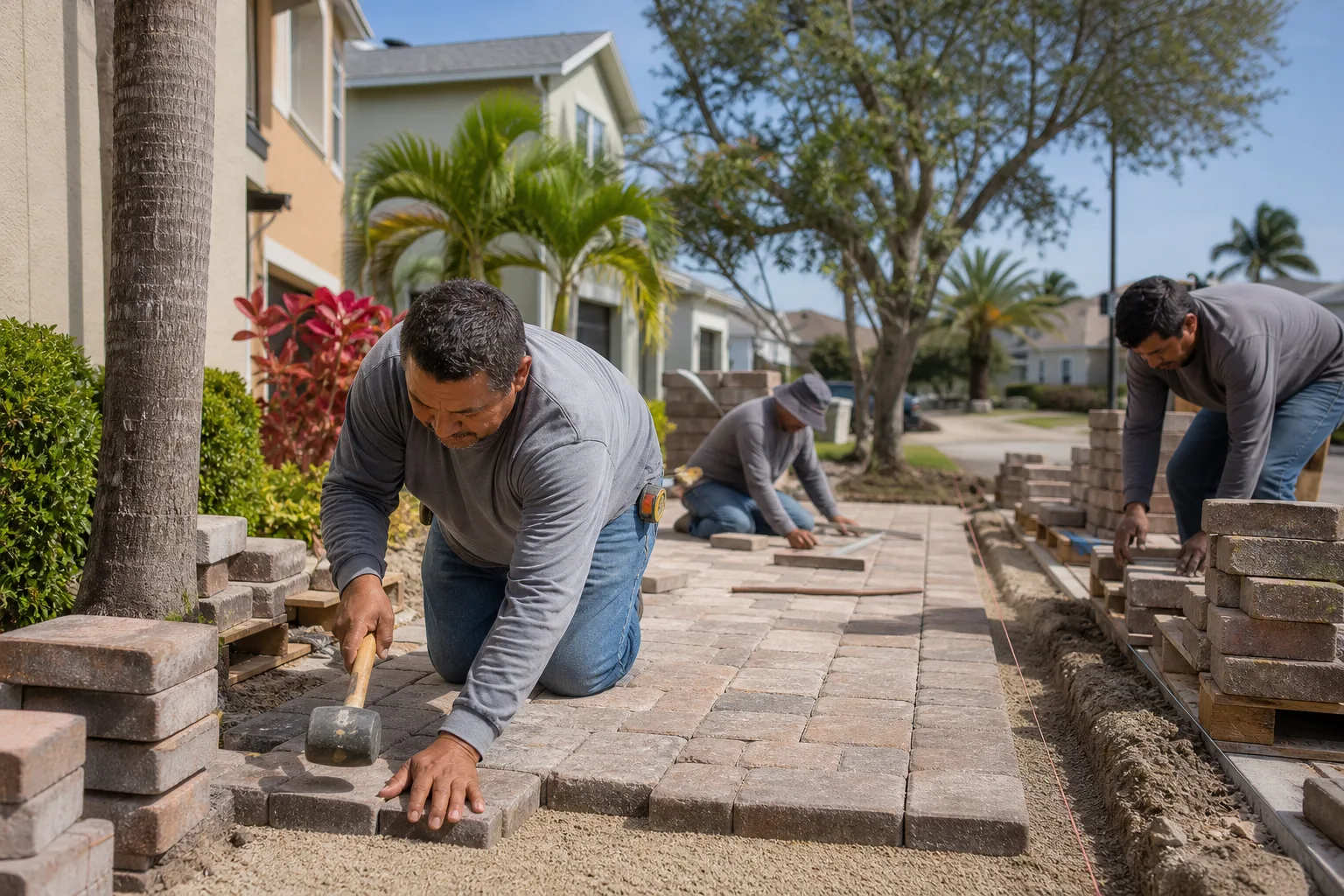
Call a professional the moment you can name the failure pattern and it’s structural, or the moment you can’t tell whether it’s cosmetic or structural and you’d rather know. Specific triggers: three or more rocking pavers in a single zone, water pooling on the surface for hours after rain, a gap that’s widened at the edge restraint, a ridge or crown that appeared without explanation, or any spalling that’s spreading across the surface. Leave it and the scope of work grows every season; a joint sand refill becomes a base rebuild faster than people believe.
Groundwork Construction Co. of North Las Vegas offers free estimates in North Las Vegas – call (844) 797-5026. Calls are answered by a live person, 24/7, and estimates come with written line-item pricing so the number you see is the number you pay. All work is backed by our 730-Day Done Right Promise: if it’s not done right, we make it right.
Frequently Asked Questions
Repairs typically range from a few hundred dollars for a joint sand refill or a small reset to several thousand for base reconstruction under a larger section. The spread comes down to how much base work is needed. Surface fixes are cheap; base fixes are the expensive part. Get a written line-item quote so you can see the difference, and call (844) 797-5026 for a free estimate – we walk the driveway with you and explain what we see.
Sometimes, and the pattern tells you which. One isolated stone that rocks slightly is often a single-stone fix. Three or more in the same area means water is moving under the base, and that’s a drainage investigation. If the rocking grew over the past month, call a professional – the trend is the tell.
Yes. Caliche is a calcium-carbonate layer common across much of the North Las Vegas valley, and it acts like a shelf that traps water under a driveway. When water can’t drain, the ground swells, and pavers heave in linear ridges or crowns. If you see a new ridge in the driveway, the fault may be the caliche, not the paver installer.
Normal wear is scuffs, color fade, and maybe a chipped corner from a wheel strike. Spalling is the surface layer flaking off across many stones, exposing the rougher core underneath. In North Las Vegas, spalling usually starts on the sun-facing side – south and west exposures – because UV is the dominant cause. Spalling isolated to one pallet’s worth of stone points to a manufacturing defect instead.
Most driveways in North Las Vegas need a top-up every one to two years, and every spring after a wet winter is the smart time. Deep or empty joints after rain, or fine sand trails washing to the street, both mean it’s time. Joint sand is cheap. Rebuilding the base that the missing sand was protecting is not.
Six to eighteen months on most failures, and that’s the entire point of this guide. The window is not indefinite, though. Pooling water, three-plus rocking stones, or a widening edge gap are signs to call now, not next year. One cosmetic sign you’re watching carefully is fine for 90 days. Anything structural is a call today.
The Bottom Line
Your driveway warns you before it fails, but only if you know the five signals: rocking, sinking, joint erosion, edge separation, and surface spalling. Learn to separate cosmetic aging from structural compromise, and you can decide in ten minutes whether to call, watch, or fix. In North Las Vegas, add caliche heave, hard water streaking, and UV spalling to your vocabulary – they’re this climate’s signature failures. The earlier you catch a structural sign, the cheaper it is, and the longer your stone holds its value. Our technicians bring up to 12 years of experience to every driveway we evaluate, and the 730-Day Done Right Promise covers the work in writing. Call (844) 797-5026 for a free estimate and design consult, and we’ll walk the driveway with you.
Written by the team at Groundwork Construction Co. of North Las Vegas.